MONDAY MUSINGS SEASON 2 - EPISODE 371
Failures are stepping stones to success
One should not abandon duties of one’s innate character, even if one sees failures in them, O son of Kunti. Indeed, all endeavours are veiled by possible failures, as fire is by smoke. (Bhagavad Gita 18.48)
As the screen of smoke blankets the energetic fire, failures can dampen our spirits at times. It is quite common to face failures. The number of failures never matters; how long it takes to bounce back from the failures matters the most,
Many great personalities have faced failures in their life before bouncing back to achieve great success. Thomas Alva Edison, Abraham Lincoln, J.K. Rowling, Amitabh Bachan, Walt Disney, Jack Ma & A.P.J. Abdul Kalam are some great personalities who have turned failures into great successes. There are many inspirational stories of those who made failures the building blocks for success. Let us get inspiration from one such story.
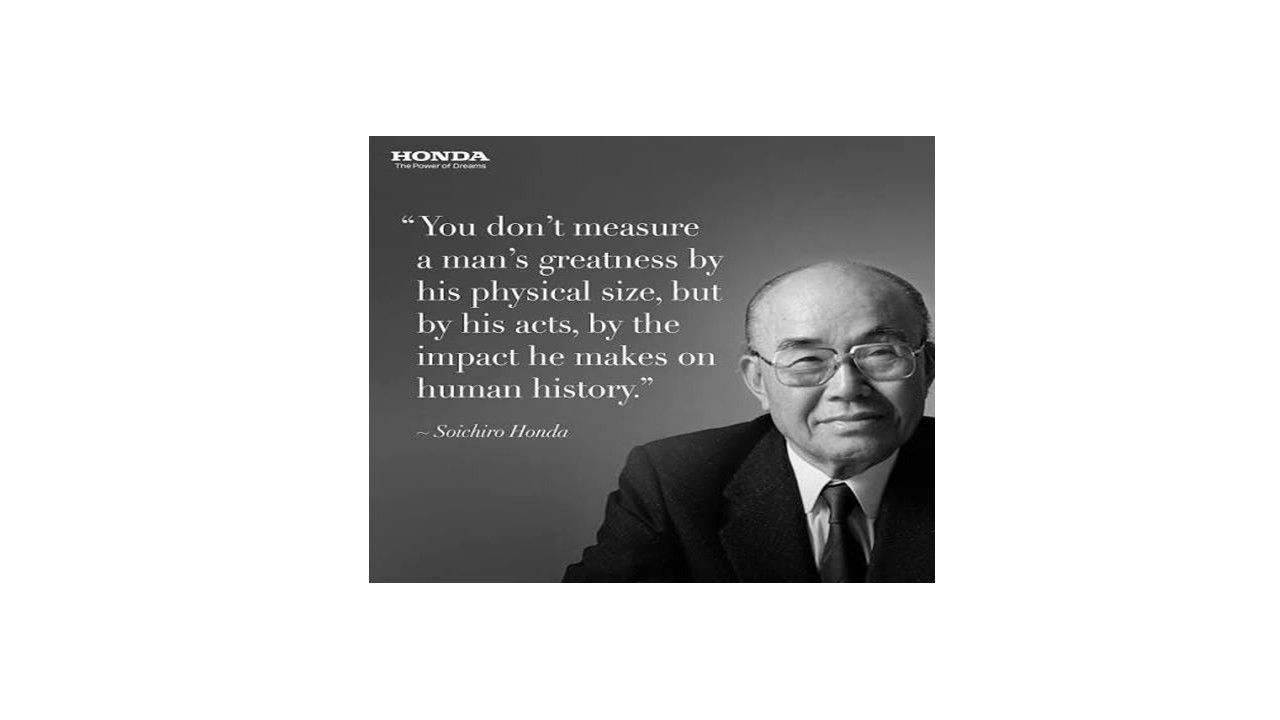
How Soichiro built Honda
Soichiro Honda faced various hurdles but never lost hope of doing something different. Perhaps that’s the reason he became the game changer in the automobile business.
Soichiro was born in a small village near Mount Fuji – Japan. His mother was a weaver, and his father used to run a bicycle repair business. Soichiro Honda was fascinated by machines from a young age and used to help in his father’s business.
Soichiro Honda left school at the age of 16 and worked in Tokyo as a trainee mechanic in an automobile shop. After his day shifts, he used to work on his skills. Soichiro designed his first racing car during that time.
After six years of work, he returned home and opened his own garage, Tokai Seiki, to produce piston rings. He laboured long hours at the workshop and even slept there. To keep things going, he pawned his wife’s jewellery. Finally, the day came when he completed his piston rings and took a working sample to Toyota, only to be told that the rings did not meet their standards!
Success, but only temporary
He refused to give up. Rather than focus on his failure, he continued working towards his goal. Then, after two more years of struggle and redesign, he won a contract with Toyota for the piston rings.
With the contract in hand, Soichiro Honda needed to build a factory to supply Toyota, but alas, the imminent war in Japan made things worse for his plans. Building materials were in short supply. He would still not quit! He invented a new concrete-making process that enabled him to build the factory.
Ramshackle of Honda gives rise to Honda Motors
Feared war came and spoiled his plans. The factory was bombed twice and steel became unavailable, too. Was this the end of the road for Honda? No!
He started collecting surplus gasoline cans discarded by US fighters – “Gifts from President Truman,” he called them, which became the new raw materials for his rebuilt manufacturing process. Finally, an earthquake destroyed the factory.
Soichiro incurred significant losses. Every employee of the company was shattered, but not Soichiro. The shattered remnants of the business were sold to Toyota and Soichiro founded a new company, Honda Technical Research Institute, with the proceeds of the sale.
After the war, an extreme gasoline shortage forced people to walk or use bicycles. Honda built a tiny engine and attached it to his bicycle. His neighbours wanted one, but although he tried, he could not find the materials and was unable to meet the demand.
Was he ready to give up now? No! Soichiro Honda wrote to 18,000 bicycle shop owners and, in an inspiring letter, asked them to help him revitalise Japan. 5,000 responded and advanced him what little money they could to build his tiny bicycle engines.
Soichiro Honda partnered with Takeo Fujisawa to form a new company, Honda Motors. Socihiro took the responsibility of product development and Fujisawa san the business. The company had just 34 employees, but one shared dream. The first motorcycle fully designed and developed by Honda from the ground up is, fittingly, called the ‘Dream’ D-type.
In the 1970s, there was another gas shortage, this time in America and automotive fashion turned to small cars. Honda was quick to pick up on the trend. Experts now in small engine design, the company started making tiny cars, smaller than anyone had seen before, and rode another wave of success.
Honda is now the largest motorcycle brand in the world, with production facilities across the globe. The entire media was shocked when he stated that he won’t share the business with his children. These unique ways of thinking led him to become the owner of a highly competitive automotive company in 1970.
Soichiro built the world’s largest motorcycle brand from the shambles of rejection, bomb raids, and earthquakes. Failure was simply not considered a possibility.
#PositiveNewsPage
Adapted from newindianexpress.com
Dozens of readers carrying novels, biographies, newspapers and academic texts gather at Central Park, Vizag every Saturday evening, turning a section of the park into an open-air reading room. The weekly gathering is part of Vizag Reads, a silent reading community that has steadily grown in Visakhapatnam over the past three years.
Founded on June 18, 2023 by Shireen Meher, Vizag Reads began as an attempt to create a simple space where people could come together around a shared interest. Three years later, it has evolved into a community that many participants describe as a place for connection, friendship and a break from pace of everyday life.
The concept itself was adopted from similar reading communities operating elsewhere. Meher and a few friends adapted the idea to suit Visakhapatnam and launched the city’s own chapter. The response surprised them. While the organisers expected only a handful of participants at the inaugural session, around 25 people attended. Since then, the community has continued to meet every Saturday from 4 pm to 6 pm at Central Park, drawing between 30 and 40 participants on a typical weekend. Larger gatherings have attracted up to 80 or 90 people.
What sets Vizag Reads apart is its simplicity. Participants arrive with their own books, find a place to sit and spend two hours reading in silence. There are no prescribed reading lists, formal discussions or book reviews. The focus remains on creating an uninterrupted space for reading. Meher said the format was designed to offer a pause from increasingly screen-dominated routines. “People are constantly working, scrolling or chasing something. I wanted to create spaces that slow us down. I wanted to create spaces that slow us down,” she said.
According to Meher, one of the most rewarding aspects of Vizag Reads has been watching friendships develop naturally. She said reading creates a different kind of interaction because conversations often begin with curiosity about a book rather than formal introductions.
The impact, Meher said, extends beyond books. Some participants have told her that the community helped them return to reading after years away from the habit. Others have spoken about finding companionship during difficult phases of life or feeling less isolated in a city where they knew few people.
“Sometimes just showing up is enough. People come because they want a quiet space to read. They stay because they find a community,” Meher said.
________________________
Conceived, compiled and posted as a motivational newsletter #MondayMusings by Jaganathan T (www.authorjaganathan.com) every Monday in LinkedIn. Read in LinkedIn for better reading experience
-
22 Jun 2026
MONDAY MUSINGS SEASON 2 - EPISODE 371
-